Care Homes cautiously optimistic about 2024
We recently conducted our latest Business Barometer research, which examines current Care Home sector trends and the view of business owners about a range of issues, from missed business opportunities to predicted business performance and artificial intelligence.
In this piece, we get under the skin of the data to find out more…
Appetite for investment
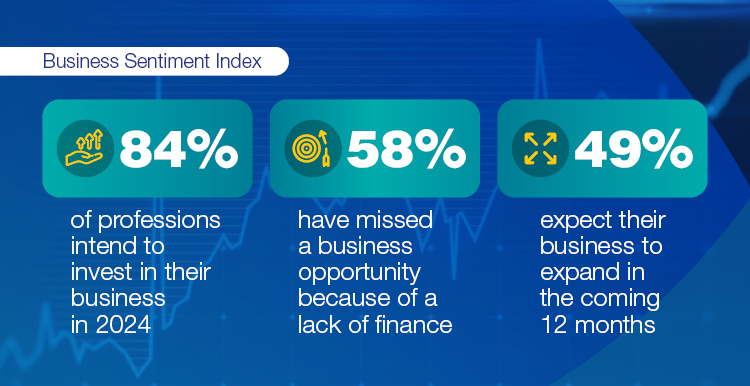
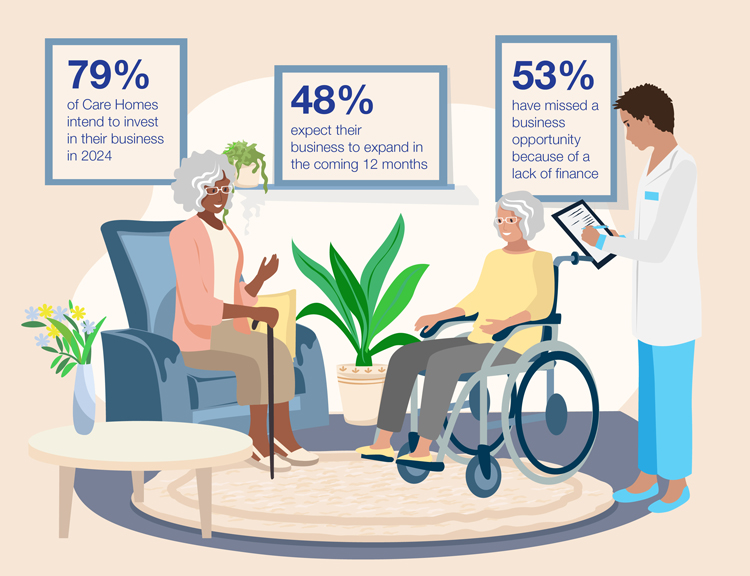
The appetite to invest in their business among Care Homes is very strong, with 79% of respondents aiming to seek funding for investment in the next 12 months. This is lower than the 84% average for the professions sector but is higher than the 73% achieved for the wider SME community.
Missed business opportunities
At 53%, the number of Care Homes that have missed business opportunities because of a lack of available funding is significantly higher than in many other sectors.
This result highlights the importance of business owners to investigate the different funding options available to them.
Economic outlook
From a macro-economic perspective, Care Homes are not as optimistic about the UK’s economic prospects as business owners in the wider professions sector.
Predicted business performance
Predictions about future business performance are – considering the various challenges business owners have faced over the past few years – positive, and points to the resilience of the Care Home sector.
Almost half of Care Homes that responded expect their business to expand during 2024, compared to 12% who think they’ll contract; the remaining 40% anticipate they will ‘stay the same’.
Acquisitions
62% of Care Homes have considered making an acquisition to grow their business or see it to own their first business.
And, according to 41% of Care Homes, they have seen a rise in the number of acquisitions in the past 12 months – 32% think there’s been a fall while 23% say there’s been no change with the rest being unsure.
Encouragingly, most Care Homes are confident about both where to go for funding (69%) for an acquisition and how to arrange the necessary funds (66%).
Artificial Intelligence (AI)
While Care Homes think AI will influence their profession in some way, they’re still largely unclear of its likely impact on their business:
- A large impact - 28%
- Some impact - 45%
- Not much of an impact - 21%
- No impact at all - 5%
- Unsure - 2%
Despite 15% of respondents being ‘very concerned’ and 46% ‘somewhat concerned’ about the rise of AI, 57% are of the opinion it presents opportunities for growth and employment.
A further 52% are looking to incorporate artificial intelligence into its business processes.
Cost of borrowing
Over half (54%) of Care Homes have seen their cost of borrowing increase, causing 69% to increase their prices.
More positively, 66% of Care Homes think interest rates have peaked, and 54% are considering alternative forms of finance to mitigate their increased costs.
Customer service
Having a named, personal contact as their funder is important for 88% of Care Homes.
According to 27% of Care Homes, the most important factor that determines good customer service by a funder is ‘expert knowledge of their profession’. This is followed by ‘the willingness to provide funding through all economic cycles’ (21%) and ‘being able to speak to a real person when I have a question’ (20%).
Business growth
Looking back over the past 10 years, the biggest inhibitors of growth for Care Homes have been:
1. Energy costs
2. Inflation
3. Interest rate rises
4. Skills shortages
5. Materials shortages
6. Influence of Brexit
Care Homes’ top five business concerns are:
1. Energy costs
2. Inflation
3. Interest rates
4. Lack of skilled staff
5. Cash flow
Methodology:*
All figures, unless otherwise stated, are from a Censuswide survey conducted in January 2024. The survey canvassed the opinion of over 1,200 senior members of the professions across the UK on a range of issues affecting their businesses.